 |
|
|
|
|
|
|
 |
|
|||||
 |
 |
 |
 |
 |
 |
|
 |
|
|||||
 |
 |
 |
 |
 |
|
|
Natural Liberation Philosophy
by William P. Meyers
Kindle edition at Amazon.com
Fed Inflation Target Should Be Zero (0%)
March 23, 2026
by William P. Meyers
Popular pages:
| U.S. War Against Asia |
| Fascism |
| Slow Motion Apocalypse |
| Towards a Government of Earth |
| Natural Liberation |
Disastrous policy should be changed
The Federal Reserves policy of seeking a 2% annual inflation target has been a disaster for ordinary Americans and needs to be amended. The bulk of evidence is that America and the world would be best served by a 0% inflation target, favoring mild disinflation over inflation.
The Fed does not operate in a vacuum. There is the real-world economy and the American component of it. There is the Federal government, with its power to tax and spend. And there many players with their own concerns adding to economic complexities.
No inflation seems like a simple idea. Below I will enquire where the current pro-inflation scheme comes from, and what class of people it is designed to benefit. First I will describe the benefits of 0% inflation and then show why the current Fed target of 2% inflation has been a disaster for most Americans. I will save my comments on the global economic and environmental effects of inflation rates until the last part of this essay.
The most obvious benefit of zero inflation is that people know what their money is worth, or at least know that better than they would under inflation. When you don't know what your money is worth, or what it might be worth in the future, if is hard to make good decisions. The natural reasoning of most people is that inflation should be zero, or at least average to zero over time. I believe that reasoning is correct.
How bad has inflation been? Keep in mind that all good and services do not inflate at the same rate. The prices of some goods come down over time. Other goods fluctuate naturally, was when a bumper crop brings down the wholesale price of wheat, while a bad crop causes the price to increase. Inflation is an average, and there are even different measures of inflation, including or excluding differing sectors of the economy, or weighing the sectors differently. [See measures of inflation]
Using the consumer price index (CPI), if you had $1.00 in 1960, to buy the equivalent bundle of goods in February 2026 you would need $11.15. In other words, if you had a dollar bill, one U.S. dollar, in 1960, and made the mistake of tucking it away, and found it today and decided to spend it, you would be able to buy the equivalent of about 9 cents, a nickel and four pennies, worth of 1960s goods. On the other hand, in 1960, you could not buy a personal computer, smart phone, or even hand-held electronic calculator. None of those things existed.
Reeling in the years, if you saved a dollar bill in 1970, you would be disappointed to find that you should have somehow saved $8.65 to have the same buying power. In 1980, $4.20. [The Horrible Seventies were marked by Stagflation.] In 1990, $2.57. In 2000, $1.94. In 2010, $1.51. In 2020, $1.27. And even as recently as January of 2025, your poor paper (or electronic) dollar would have needed to expand to $1.03 to keep up with commodities.
Inflation encourages spending over savings. That has broad effects on society, including the current paycheck-to-paycheck culture. Deflation (which had occurred at points of American history (and in other nations) has the opposite effect: it encourages waiting to buy things, because they will become cheaper. But usually inflation is slow enough that this effect is not obvious to the average person.
The current Fed target of 2% inflation has been a disaster for most Americans. Most obviously, the Fed has failed to hit that target. Over and over and over, the Fed has let inflation go over 2% per year.
This graph from PIMCO shows the annual rates of inflation going back to World War I:
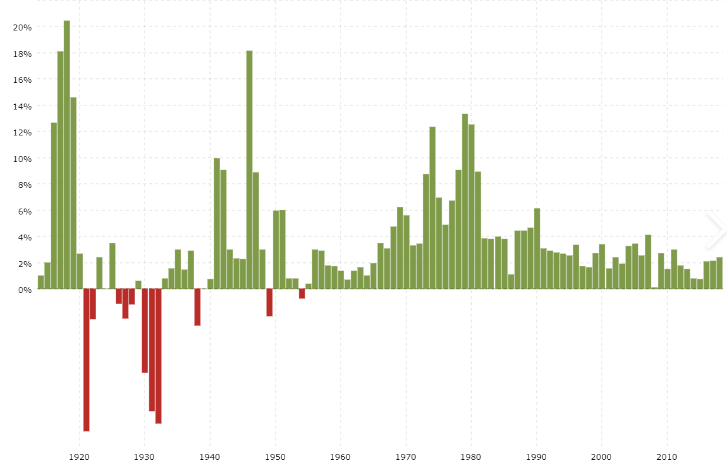
The last times there were negative inflation rates were in the 1950s, for one year, and in 2009, after the housing market collapse. Inflation below 0% simply has not been a problem in modern times. This graph shows more detail, post 2020, to 2025:
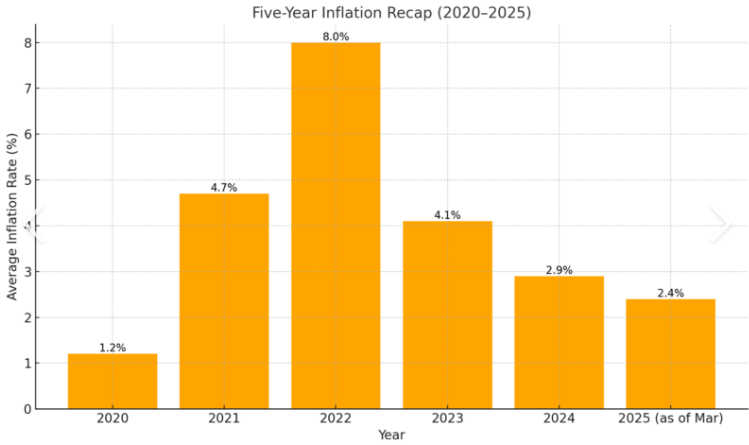
Inflation was only under 2% one year, in 2020, but was way above that the following four years. These historical data make the case that the Fed does not prioritize limiting inflation. The 2% is not a target, but the bottom of a range they like. This has been a disaster for most Americans, because they do not have the bargaining power to get a fair return on their savings, or their wages. It has been a slow, creepy disaster, for instance for those unable to save enough to buy housing instead of renting it.
Where did the 2% inflation target come from? According to the Federal Reserve, "Monetary policy in the United States comprises the Federal Reserve's actions and communications to promote maximum employment, stable prices, and moderate long-term interest rates--the economic goals the Congress has instructed the Federal Reserve to pursue." The Fed reaffirmed the 2% goal in 2012 and on January 27, 2026. The official rational is: " the ability of the Federal Open Market Committee (FOMC) to lean against the adverse effects of deflation through cuts in its target for the federal funds rate becomes limited once the target has been reduced to zero. This limited ability is a primary reason why the FOMC sees modestly positive yearly inflation at the rate of 2 percent-as distinct from a constant price level-as most consistent with its statutory mandate. That said, 2 percent is sufficiently away from deflation that the FOMC sees the costs of positive and negative deviations from that inflation goal as symmetric."
The dual mandate, including the 2% goal, was placed in the Federal Reserve Reform Act of 1977. The 2% target itself was put in place in January 2012. The statistic used by the Fed is the Personal Consumption Expenditures (PCE) index, which usually trends with the CPI over time. The Fed had been around for decades by 2012, so you might say it had plenty of pragmatic experience to use in setting the inflation goal. However, in 2012 the nation was still recovering from the housing mortgage meltdown, and inflation was relatively low.
I don't buy the Fed's explanation for its 2% inflation rate and the usually higher rates that result from that. So what is really going on?
The second part of the mandate is full employment. Is that out of sympathy for the working class? No (though individual Fed members, none of whom are appointed from the working class, could have some sympathy). Full employment maximizes the economy, which maximizes the profit and wealth of the capitalist class. Unemployment indicates employers (capitalists) are not taking full advantage of the opportunity.
Inflation does diminish the U.S. National Debt, in fact all debt, over time (makes it easier to pay back, with set interest). However, those who make loans (mostly capitalists, but ordinary savers are effectively making loans) take inflation into account when setting the interest rate at which they are willing to lend. When inflation is high U.S. long-term bond interest rates are high, as are mortgage loans, car loans, and credit card loans.
The main beneficiaries of high inflation are the holders of real assets that produce profits. Those assets include factories and rental housing. 2% and higher inflation does not improve the economy. It improves the economy of the economically powerful.
The economically powerful are a diverse set, when you focus in on them. Some own rental properties, some factories, some software companies, wholesalers, retailers. Some own banks, and some are simply investors or advisors to investors.
Keep in mind that small thefts can add up to big thefts. 2% a year, for one year, for the dollar bill sitting idle in a purse is only the loss of 2 cents. But all of the money is losing value at the rate of inflation each year. Most of the money is simply held with accounting mechanisms; you could call it electronic. A fair measure might be what the Fed calls the money supply, of two kinds, M1 and M2. M2 includes M1, so is larger. A recent estimate (January 2026) of it is $22.44 trillion dollars. 2% of that is $0.45 trillion. That is, $4,500 billion. That is a lot to disappear in a year, one would think.
The trick is (to simplify a bit), the money supply is increased, by Federal Reserve actions, each year to more than make up for the inflationary loss of value. The money supply grows faster than the economy as a whole. And it grows through a multiplier that works in favor of big banks and their Wall Street equivalents (or perhaps superiors). [Complicated, but explained in economics textbooks and papers.]
So if you are a worker, and your wages stay flat for a year, you lose at the rate of inflation, as far as your ability to buy things (or to save the difference). If you are a capitalist, you sell your product (goods, services, investments) at the going (inflated) rate, keep wages flat, and pocket the difference. [Inflation has risen faster than wages for decades now.]
Banks (large commercial banks) in particular benefit from this policy. For quite some time now they have offered savings rates near zero, while keeping load rates high.
Of course, even capitalists can make mistakes. They can lose money, even go bankrupt. Occasionally a big bank goes bankrupt. It is complicated. Workers may get a wage through a promotion, so individually they may be able to cope with inflation, although wages remain flat overall, or rise slower than inflation.
American voters should urge Congress to officially set Federal Reserve policy to target 0% inflation. Prices will fluctuate in any case, but 0% is fair, predictable, and likely to benefit the overall economy most in the long run.
| Copyright 2026 William P. Meyers. All rights reserved. |